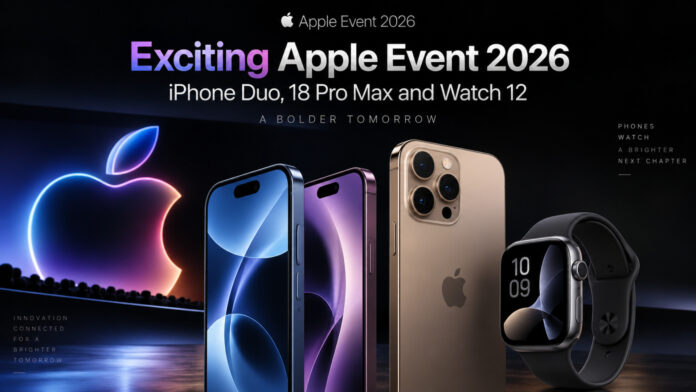
Apple could finally be ready to enter the foldable phone market, and the wait may be almost over. The long-rumored foldable iPhone is expected to make its debut at Apple’s September 9 event, potentially introducing a radically different iPhone design and a new premium tier for the company.
For years, Apple has watched Samsung, Google and other manufacturers experiment with folding displays while keeping its own plans under wraps. Now, multiple reports point toward a book-style device that could be marketed as the iPhone Ultra.
Apple has not confirmed the product, its name or any specifications. But the volume and consistency of recent leaks suggest that this is no longer just a distant prototype. Here is what the latest reports indicate — and what remains uncertain.
Foldable iPhone could be unveiled on September 9
The biggest development is the timing. Apple is scheduled to hold its major iPhone event on September 9, with the iPhone 18 Pro and iPhone 18 Pro Max expected to headline the event. The foldable iPhone is now widely expected to appear alongside them.
That would make this one of Apple’s most important iPhone launches in years.
Reports earlier in 2026 suggested Apple could face manufacturing problems and delay the device. Bloomberg’s Mark Gurman subsequently reported that the foldable remained on track for a September introduction, while supply-chain reports also pointed toward a fall unveiling.
However, there is an important distinction between unveiling the foldable iPhone and making it widely available.
Analyst Ming-Chi Kuo has suggested that manufacturing constraints could push preorders or shipments into the fourth quarter. In other words, Apple could show the phone this week while asking customers to wait longer before they can actually buy it.
That would not be unprecedented. Apple followed a similar strategy with the iPhone X in 2017, unveiling it alongside other iPhones but releasing it weeks later.
What will the foldable iPhone look like?
The strongest leaks point to a book-style foldable, rather than a small clamshell phone like the Galaxy Z Flip.
When closed, the device is expected to resemble a conventional smartphone. Opening it would reveal a much larger internal display, giving the phone some of the characteristics of a small tablet.
Current reports point to:
- A roughly 5.5-inch outer display
- A roughly 7.8-inch internal folding display
- A wider, passport-like aspect ratio
- A thinner design than many existing foldables
- A hinge engineered to minimize the visible display crease
The 7.8-inch internal panel would put the device in the same broad territory as a compact tablet, making it considerably larger than the display on a conventional iPhone.
The crease is particularly important. Apple has reportedly been working to make the folding area less noticeable, while durability concerns around the hinge have been a major engineering challenge.
If Apple has genuinely solved those problems, the physical design could become one of the phone’s biggest selling points.
The iPhone Ultra name is still a rumor
Apple’s foldable iphone has increasingly been referred to as the iPhone Ultra, but that name should not be treated as confirmed.
Apple already uses the Ultra branding for products such as the Apple Watch Ultra, and reports suggest the foldable would sit above the regular iPhone lineup as an expensive flagship rather than replace the iPhone Pro Max.
That positioning would make sense. A foldable display, specialized hinge and low initial production volumes would make the device substantially more expensive to manufacture than a traditional iPhone.
Some reports have placed the expected starting price around $2,000 to $2,500, with Kuo estimating approximately $2,299 to $2,499. Those figures remain predictions rather than official pricing.
For comparison, Apple’s conventional flagship iPhones cost far less, meaning the foldable iPhone would effectively create a new luxury category within the iPhone family.
Foldable iPhone specs could involve some compromises
Apple’s first foldable iphone may not simply be an oversized iPhone Pro Max with a folding screen.
Recent leaks suggest the device could use two rear cameras rather than the more elaborate camera system found on Apple’s Pro models. It may also replace Face ID with Touch ID integrated into the power button.
That would be an unusual decision for a premium iPhone, particularly because Face ID has become a defining part of Apple’s modern smartphone design.
The rumored hardware package also includes Apple’s next-generation A-series silicon and a C2 modem, although exact specifications have not been confirmed.
The potential compromises highlight Apple’s likely priorities. Rather than making the foldable iphone the ultimate camera phone, Apple could be focusing on portability, screen size, durability and the software experience.
That strategy would distinguish the device from the conventional iPhone Pro Max instead of simply turning it into a more expensive version of the same product.
Why Apple waited so long to make a foldable iphone
Apple’s late arrival is significant.
Samsung introduced its first Galaxy Fold in 2019, and companies including Google, Motorola, Huawei and Xiaomi have since developed increasingly mature folding phones. Apple, meanwhile, has spent years reportedly testing different designs without bringing one to market.
That caution may finally be paying off.
Foldable phones have improved considerably since the first generation. Hinges are thinner, displays are more durable and software has become better adapted to changing screen sizes. The industry has also moved toward larger book-style foldables that combine smartphone portability with tablet-like displays.
Yet foldables remain a relatively small part of the broader smartphone market. Reuters reports that foldables accounted for only a small share of smartphone sales, while Apple entering the category could dramatically increase consumer awareness and demand.
Apple has historically preferred entering a category after the underlying technology has matured. The company’s approach with the foldable iPhone appears to follow the same pattern: wait, refine the experience and then enter with a product designed around Apple’s ecosystem.
The software could be Apple’s biggest advantage
Hardware will attract attention, but software may determine whether Apple’s foldable succeeds.
Android foldables have already demonstrated the usefulness of larger screens for multitasking, gaming, video and productivity. Apple’s advantage would be its control over both the operating system and hardware.
A successful foldable iPhone could switch seamlessly between a conventional phone interface and a larger, tablet-style layout when opened.
Developers would also have an incentive to optimize major applications for Apple’s unusual display because the iPhone user base is so large. Analysts have suggested that this software ecosystem could give Apple an advantage over competitors that still encounter inconsistent app support on foldable devices.
The result could be more important than the hardware specifications themselves.
What the launch could mean for iPhone buyers
The foldable iPhone is unlikely to replace the standard iPhone for most people immediately.
Its rumored price alone puts it in a different category. Instead, Apple appears to be creating an ultra-premium option for customers who want a larger screen without carrying both a phone and tablet.
For buyers, the biggest advantages could include:
- A tablet-sized screen that folds into a phone-sized device
- Better multitasking and media consumption
- A new form factor within the Apple ecosystem
- Potentially improved portability compared with carrying an iPhone and iPad separately
The disadvantages could be just as significant: a much higher price, potentially limited initial availability and possible compromises in cameras or biometric authentication.
That makes the first generation more of a technological showcase than a mainstream upgrade.
The launch matters beyond Apple’s own product lineup.
Samsung has spent years establishing itself as the dominant name in foldable smartphones, while Chinese manufacturers have pushed aggressive designs and thinner hardware. Apple’s entry could force the entire market to compete more heavily on thickness, hinge durability, display quality and software optimization.
Apple’s enormous customer base could also give the category a major boost. Reuters reports that analysts expect Apple’s foldable to generate significant revenue despite its premium positioning, with demand potentially exceeding the company’s initial production capacity.
That creates an interesting situation: Apple may not need the foldable to become a mass-market product immediately. A high price and limited supply could actually reinforce its premium positioning.
What happens next?
The biggest questions should be answered on September 9.
Apple is expected to reveal its next-generation iPhone lineup at the event, and the foldable iPhone could be the surprise that dominates the keynote. The device is rumored to launch as the iPhone Ultra, but Apple could still choose a completely different name.
More importantly, the company needs to clarify availability. Even if the phone is unveiled this week, reports of constrained production mean customers may not receive it immediately.
After years of rumors, Apple’s first foldable is finally close enough to become a real product rather than an endless leak-cycle story.
Also read: iPhone Fold Ultra Leak Reveals Premium Design and A20 Pro Chip Specs
The foldable iPhone could mark a new era for Apple
The arrival of the foldable iPhone would be one of Apple’s biggest design shifts since the company moved from the home-button era to Face ID and edge-to-edge displays.
The leaks paint a picture of a premium, book-style device with a large internal screen, a focus on thinness and durability, and a price far above Apple’s conventional iPhones. But until Apple takes the stage, specifications, pricing and even the iPhone Ultra name remain unconfirmed.
What is becoming increasingly difficult to dismiss is the launch itself. If Apple does unveil its foldable this week, it will enter a market that has already spent years evolving — but with the potential to redefine what consumers expect from a foldable phone.